00Production record review · 21 CFR 211.192

The investigation shall extend
to other batches.

That sentence has been in the Code of Federal Regulations since 1978. It is why a single deviation turns into a three-to-five week paper exercise across every batch of the same product. encompass360 makes it one screen.

2,755 FDA citations against §211.192 across 1,776 sites, and FY2025 was the highest count since 2011.

FY09one cell per fiscal year, colour is the countFY26

01Trusted on production lines at

02The same review, before and after

Before a two-hundred-page record, printed page by page and read by hand. This is the client’s own report output. After the same review on one screen, every source read where it lives. Scroll to wipe between them.

03Stated by an engineer, unprompted

The historian was never built to hold batch context.

“Ignition’s built-in historian doesn’t provide a way to attach context to a record (like a batch ID). I could use the built-in historian and use table joins and timestamp comparisons, but to me that’s worse… Is there a best practice for storing ‘contextualized’ timeseries data?”

Inductive Automation forum, March 2022

Two years later, on the same forum, a senior engineer answers the same question bluntly: the historian “isn’t designed to correlate your batch-active tag with any other tag. Or any tag with any other tag.” The workaround is always the same: transaction groups writing to conventional SQL tables, hand-building the context the historian will not hold.

And the failure mode is precise: if the batch-active flag is written a millisecond before the process value, that final reading falls outside the query window and silently never appears in the batch view at all. Nobody sees a gap. There is nothing to see.

From the plant floor

Engineers hand-build the context

Forum threads from 2022 and 2024 land on the same workaround: transaction groups writing to conventional SQL tables, because the historian will not hold a batch ID next to a tag.

From the architecture

The historian was built for numbers

A historian excels at numeric time-series and handles text badly (audit trails, batch information, user records) because of its long, narrow data structure. A relational database is the exact inverse.

HISTORIAN · LONG AND NARROWtimestamptagvalueq08:14:02TT-401271.2OK08:14:02PT-40301.86OK08:14:02AG-4001212ALM08:14:12TT-401271.4OK08:14:12PT-40301.86OK08:14:12AG-4001209OKone row per tag per changeno batch. no operator. no recipe.A REVIEW · WIDE AND CONTEXTUALtimestampbatchphaseTT-4012PT-4030AG-4001operator08:14:02B-24067DRY71.21.86212ID 331208:14:12B-24067DRY71.41.86209ID 3312the shape a reviewer readsthe historian cannot produce thisjoin
The structural mismatch, stated independently by an Ignition-forum engineer in 2022, by an r/SCADA engineer in 2026, and in Synerlytics’ own architecture deck. A historian is excellent at the left shape and cannot produce the right one. Joining them by timestamp, by hand, is the three weeks.

Two independent groups reached the same conclusion. Neither system is wrong; neither is sufficient alone. encompass360 layers both, which is why the batch view holds the trend and the audit trail and the recipe and the genealogy on one axis, instead of making a reviewer join them by timestamp and hope.

04The problem

Every plant runs on islands of data.

The historian holds the trend. The SCADA system holds the alarms. The batch system holds the phases. The MES holds the recipe and its limits. The LIMS holds the result. The BMS holds the room. Each one is correct, and none of them talk to each other.

So when the Quality Control Unit has to review a production record before release, somebody assembles all of it by hand. That is the three weeks. Not the analysis. The assembly.

  1. 01

    The regulator is specific

    §211.192 requires investigation of any unexplained discrepancy, and names theoretical yield outside its established range as an example.

  2. 02

    It compounds across batches

    The investigation must extend to other batches of the same product. One deviation becomes a campaign-wide review.

  3. 03

    It blocks release

    All of this happens before a batch is released or distributed. The review sits on the critical path to shipping product.

05The product

Every system that touched the batch, on one time axis.

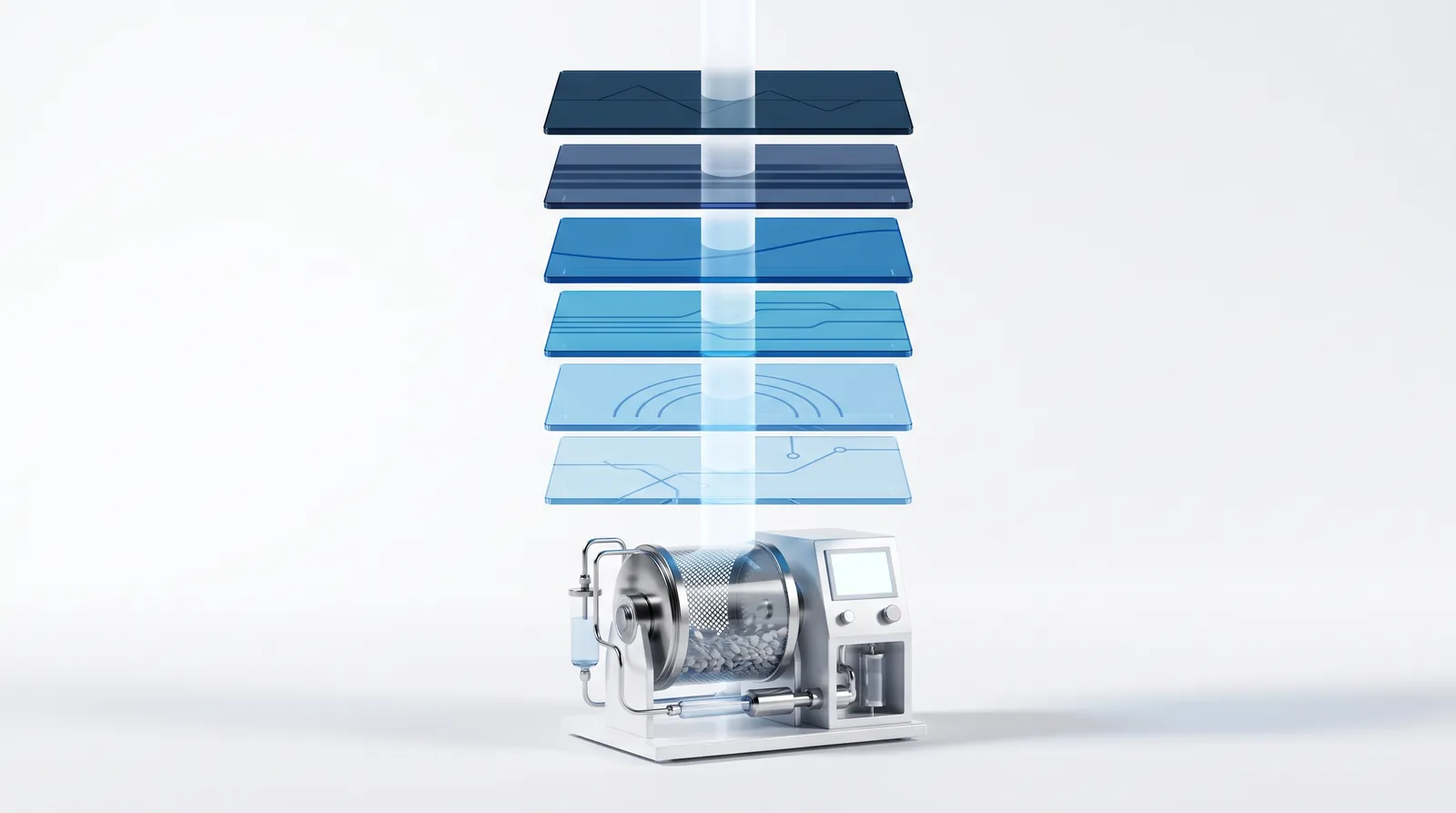
Batch at a Glance layers six independent sources onto a single contextualised view. Nothing is copied, nothing is transformed, and the source records stay exactly where they are. Each row below is one layer of the figure beside it.

01Historian analog data OSI/AVEVA PI, Proficy Historian: the process trend itself 211.188
02Alarms and events from SCADA, inline against the trend that caused them 211.100
03Recipe phases ISA-88 phase boundaries marked on the time axis 211.186
04Alarm limits and spec bands from the MES and recipe system, not hand-drawn 211.110
05Batch metadata and genealogy lot, equipment, and every component lot consumed 211.188(b)(3)
06Room conditions BMS and environmental monitoring for the same window 211.46
ONE BATCH, ONE TIME AXISTIME โ†’FORCETURRETSRELPRE-COMPWEIGHT01 HISTORIAN ยท FIVE TAGS ยท COLOUR IS VALUE02 ALARMS AND EVENTS03 RECIPE PHASES04 SPEC BAND05 LOTS CONSUMED06 ROOM01 THE PROCESS TREND ITSELF02 ONE ALARM, AT THE EXCURSION03 PHASE BOUNDARY, FROM THE RECIPE04 SPEC BAND FROM THE MES05 THE LOTS THIS BATCH CONSUMED06 ROOM CONDITIONS, SAME WINDOWAlarms and eventsRecipe phasesHistorian analog dataAlarm limits and spec bandsHistorian analog dataRoom conditionsBatch metadata and genealogy
01 ⁄ 06 sources on the axis Point at any layer, or at a row One batch, one time axis. Each source below is added to it as you reach it. Historian: the process trend itself, read where it lives in PI, drawn onto the axis first. Alarms and events from SCADA, placed at the moment they fired. The amber one fired at the excursion. Recipe phases: ISA-88 phase boundaries on the same axis, so the excursion has a phase. Alarm limits and the specification band from the MES, not hand-drawn. The trend leaves it at the alarm. Batch metadata and genealogy: the component lots this batch consumed, attached to the record. Room conditions from the BMS for the same window, in their own strip beneath. All six, one batch, one time axis. Schematic here. In the live demo two are read from the data itself, the trend and the component lots; phases, limits and events are derived from that trend rather than read from a recipe system; room conditions are labelled synthetic.

06What customers say when they see it

“We currently have no idea what’s going on in our batches.”

That is the reaction, reported by the engineer who has demonstrated this software for thirty years. Not “this is faster”, but this is what we need to see.

And the review does not happen in one place. A quality reviewer investigating a batch that ran three weeks ago sits at a workstation with a large screen and compares batches side by side. Maintenance carries a tablet. Both are looking at the same record; neither should be told to use the other one’s tool.

07The platform, the reason, the company

The platform

Compare any batch. Prove every record.

One contextualised view is the foundation. On top of it: one-touch batch comparison, multivariate analytics, twelve families of audit-ready reports, and a verification engine that audits its own data.

Explore encompass360 →

Why Synerlytics

Integrity is the whole game.

Your data decides whether a batch ships and whether an audit clears. We hold every record to ALCOA+ and 21 CFR Part 11, prove it, and take recurring cost out of the line as we do. A validated path to the Unified Namespace.

Why data matters →

The company

Built by the engineers who wired these lines.

Three brand eras and twenty years of live production behind one platform. Thirty-plus years in life-sciences manufacturing, expertise across every layer of the floor, teams in New Jersey, Oregon and Puerto Rico.

Meet Synerlytics →

08For the evaluation

Six people decide. Each asks a different first question.

A regulated purchase is reviewed by a committee, and every seat reads this site for something different. The first question each one asks, and where it is answered.

SeatFirst questionWhere it is answered
QA batch record reviewer8 to 15 records a week Can I review by exception without opening six systems, and without being told what to disposition? The live demo opens on disposition, CQA result and CPP departures, lists every exception with its discrepancy state in §211.192’s words, and extends the investigation to other batches in one control. On 1,005 real batches.
Controls and automationPI, Ignition, Rockwell What does it read, and what happens at 3 am when store-and-forward backs up? Connections: OSI/AVEVA PI, Proficy, FactoryTalk, Ignition, MES and LIMS. Redundancy, store-and-forward and health alerts on Data Matters.
CSV and validationtheir answer gates the purchase How do we validate it, and which technical controls does it give us under Part 11? A read-only review layer with an audit trail throughout, and the sources’ own audit trails read in place; the ALCOA+ mapping to §11.10(b), §11.10(d) and §211.68(b) is on Data Matters. Supplier questions go to the engineers who built it.
Plant IT and OT securitynothing touches the process network unsigned What connects to what, in which direction, and who can see it? Source records stay where they are and are never rewritten; the review layer reads each source and writes nothing back. SSO / SAML, role-based access, thin client, virtualised or browser delivery, stand-alone or enterprise. Where it runs.
Procurement and vendor riskdiligence on a two-principal vendor Who is behind it, what has it run on, and what happens to us if that changes? Thirty-plus years in life-sciences manufacturing, three brand eras and twenty years of live production, teams in New Jersey, Oregon and Puerto Rico. The company. Continuity questions go to the founders directly.
The linethe people who run it What did it actually change on a line like ours? One ibuprofen line: the review that took three to five weeks, and what it took after. Figures are the client’s own.

09Review by exception

The point is not to read two hundred pages.

A reviewer needs to know one thing first: does this batch need my attention? Batch at a Glance opens with the disposition, the CQA result against specification, whether theoretical yield tripped its §211.192 trigger, and how many critical process parameters departed from the golden master.

Everything else is one click away, and stays out of the way until it is asked for.

24 RELEASED BATCHESTIME โ†’
Most batches sit inside the band and are never read. The one that leaves it is the review. The band is the distribution of released batches at the same strength, so departure is measured against the process as it actually runs, not against one hand-picked run. Schematic, synthetic data: twenty-four released batches against time, colour is departure from the golden master. The demo draws the real one from 1,005 batches.
The band

Golden master, not a golden guess

The comparison band is computed from the distribution of released batches at the same strength, not one hand-picked reference run.

The join

Process joined to result

The trend is shown against what the batch actually produced: dissolution, weight variation, yield, impurities. Cause and consequence on one screen.

inspection citations under §211.192 since FY2009
distinct sites, by FDA establishment identifier, told in writing they have this problem

On 25 August 2026, after the records plotted above, the FDA cited a manufacturer under §211.192 as violation number one: “failed to thoroughly investigate any unexplained discrepancy.” This is current enforcement, not a historical example.

0113226FY2009: 163 citationsFY09FY2010: 180 citationsFY2011: 226 citationsFY2012: 171 citationsFY2013: 172 citationsFY2014: 149 citationsFY2015: 168 citationsFY2016: 174 citationsFY2017: 151 citationsFY2018: 150 citationsFY2019: 179 citationsFY2020: 86 citationsFY2021: 77 citationsFY21FY2022: 126 citationsFY2023: 127 citationsFY2024: 139 citationsFY2025: 209 citations209FY25FY2026: 108 citationsFY26 CITATIONS PER FISCAL YEAR
Every FDA inspection citation against §211.192 since FY2009: 2,755 in total, across 1,776 sites by FDA establishment identifier, which are 1,680 named companies. The FY2021 trough is the inspection pause; FY2025 is the highest count since 2011. Pulled from the FDA Data Dashboard API on 2026-09-08; the published records run to 9 July 2026.

The demo runs on published production data: 1,005 batches and 4,720,208 process samples from a real solid-dose line, released under CC BY 4.0. No customer records are used anywhere on this site.